VidAU Editorial · AI Search
Agentic AI Workflow Breakdown Enterprise News 2026: April Edition
See April 2026’s biggest enterprise AI agent news and turn it into action. Get agentic workflow blueprints, architecture patterns, build-vs-buy guidance, governance tips, and a 30-60-90 day rollout plan.
By the VidAU Editorial Team · Reviewed before publishing

April 2026 shifted Agentic AI Workflow Breakdown enterprise AI from chatty assistants to executable agents. This brief turns Nvidia’s enterprise AI agent platform, OpenAI Workspace Agents, and Anthropic’s Claude Mythos into production-ready patterns with the guardrails enterprises require.
April 2026 shifted enterprise AI from chatty assistants to executable agents. This brief turns Nvidia’s enterprise AI agent platform, OpenAI Workspace Agents, and Anthropic’s Claude Mythos into production-ready patterns with the controls, auditability, and KPIs that CIO and CTO teams need in 2026.
Quick Summary
• Nvidia’s enterprise AI agent platform is the top near-term backbone for order-to-cash automation across Salesforce and SAP, with Adobe for content and LangChain or AutoGen for orchestration.
• OpenAI Workspace Agents and Anthropic Claude Mythos provide strong alternatives for office-suite workflows and security-centric use cases, with Claude Code enabling computer use execution.
• Enterprise rollouts in 2026 should enforce sandboxed execution, RBAC, audit logging, policy-as-code, and human-in-the-loop signoffs per Gartner’s adoption cautions.
• CIO, AI product, and data platform leaders benefit most by piloting one high-value workflow, proving KPIs in 60 days, then scaling with observability and incident runbooks.
What Is an Agentic AI Workflow?
An agentic AI workflow is a set of autonomous yet governed steps in which AI agents plan, decide, and execute tasks across enterprise systems. Unlike chat assistants, agentic workflows integrate tools, APIs, and UI actions to complete outcomes end to end, with policies, audit trails, and human review where needed to meet security and compliance requirements in 2026.
Agentic AI Workflow Breakdown Enterprise News 2026: The April Signals
April 2026 enterprise news signaled a pivot from conversational copilots to executable, secure agents:
• Nvidia’s enterprise AI agent platform surfaced with named adopters like Adobe, Salesforce, and SAP, indicating readiness to run across core enterprise stacks and content ecosystems.
• OpenAI introduced Workspace Agents positioned for end-to-end office and business workflows, with GPT-5.5 referenced as part of its enterprise vision.
• Anthropic announced Claude Mythos for cybersecurity detection and response, alongside Claude Code computer use that can act as an execution agent on managed endpoints.
• Gartner’s signals highlighted rapid adoption of AI agents in enterprise software, with emphasis on governance, auditability, and change controls.
• Additional signals included Qwen 3.6 Plus previews, Nvidia NemoClaw discussions on secure agents and risk, SAGTEC Global’s agentic orchestration layer for enterprise workflows, and open-source momentum such as OpenClaw featured on the TED stage.
• Practitioner frameworks remain pragmatic choices: LangChain, AutoGen, and CrewAI are widely used to orchestrate multi-agent patterns and tool use, with IBM Technology content helping teams structure production architectures.
These signals collectively point to 2026 as the year enterprises standardize on agentic patterns that can plan, decide, and execute in production under strict controls.
Suggested Visual: Timeline showing the April 2026 signals mapped to enterprise capabilities and risk controls.
Blueprint 1: Order-to-Cash on Nvidia Platform Signals with Salesforce, SAP, and Adobe
Objective: Automate quote-to-invoice-to-cash collection while improving conversion, DSO, and compliance.
Inputs and systems
• CRM and CPQ: Salesforce
• ERP: SAP
• Content generation: Adobe for templated collateral
• Orchestration: LangChain or AutoGen for multi-step planning and tool calls
• Optional: CrewAI for specialized sub-agents (pricing, risk, collections)
Workflow steps
1) Opportunity to quote: The agent pulls opportunity data from Salesforce, retrieves pricing rules and contract terms, and proposes a quote. It drafts collateral in Adobe templates and routes to the owner for approval.
2) Quote to order: On approval, the agent converts to order, checks SAP inventory and fulfillment lead times, and updates the delivery schedule.
3) Invoice creation: The agent triggers SAP billing, generates the invoice, and sends it to the customer while updating the customer portal.
4) Collections and risk: The agent monitors payment status, proposes dunning messages tailored by customer profile, and escalates to collections with a concise risk summary.
5) Exceptions: For discounts beyond policy, data mismatches, or large-dollar changes, the agent creates a ticket, assembles evidence, and requires a manager signoff.
Guardrails and policy
• RBAC and SoD: Separate privileges for quoting, pricing overrides, and billing actions.
• Policy-as-code: Enforce discount thresholds, payment terms, and credit checks; embed justification prompts and mandatory fields.
• Audit logs: Record prompts, decisions, system calls, outputs, and human approvals.
• Human-in-the-loop: Mandatory signoff for non-standard terms, high-value orders, and write-offs.
KPIs and success criteria
• Lead-to-quote cycle time, quote win rate, order accuracy, invoice accuracy
• DSO reduction and aging bucket improvements
• Exception rate and median approval time
• Policy violations prevented and audit completeness score
Why this fits April 2026
• Nvidia’s platform signals enterprise-grade agent orchestration across Adobe, Salesforce, and SAP ecosystems.
• Teams can start with LangChain or AutoGen for orchestration and progressively adopt platform-native adapters as they mature.
Suggested Visual: Swimlane diagram showing agent steps, human approvals, and system integrations from lead to cash.
Governance Pattern: Claude Code Computer Use as an Execution Agent

Claude Code’s computer use acts like an execution agent on managed desktops or VMs. Treat it as privileged automation that must be tightly sandboxed.
Controls and design choices
• Sandboxed execution: Run in a hardened VM or container with egress controls, ephemeral credentials, and software-restriction policies; restrict file system access to predefined workspaces.
• RBAC and PAM: Limit roles by task domain, rotate credentials, and scope tokens for least privilege; integrate with enterprise identity providers.
• Policy gates: Encode change windows, segregation of duties, and approval gates for script changes or sensitive actions.
• Audit and forensics: Capture screen actions, command logs, file diffs, and hashes; store immutable logs for review.
• Escalation paths: On anomaly detection or repeated retries, pause and notify an on-call engineer; require human acknowledgment.
• Model and tool updates: Apply staged rollouts with canary users and rollback plans; document tool versions in each execution trace.
Operating guidance
• Use a portfolio approach: Assign execution tasks to specialized sub-agents with narrow scopes rather than a single super-agent.
• Start with read-only: Pilot in shadow mode collecting diffs; move to write actions with approvals; then to limited autonomous windows.
• Align with Gartner cautions: Combine policy-as-code, observability, and change management to reduce operational and regulatory risk.
Key Takeaways
• Treat computer use as privileged automation with strict sandboxing and RBAC.
• Log every action and require approvals for sensitive changes.
• Progress from read-only shadowing to constrained autonomy with rollback plans.
Suggested Visual: Architecture diagram showing Claude Code in a sandbox VM with RBAC, audit pipeline, and escalation service.
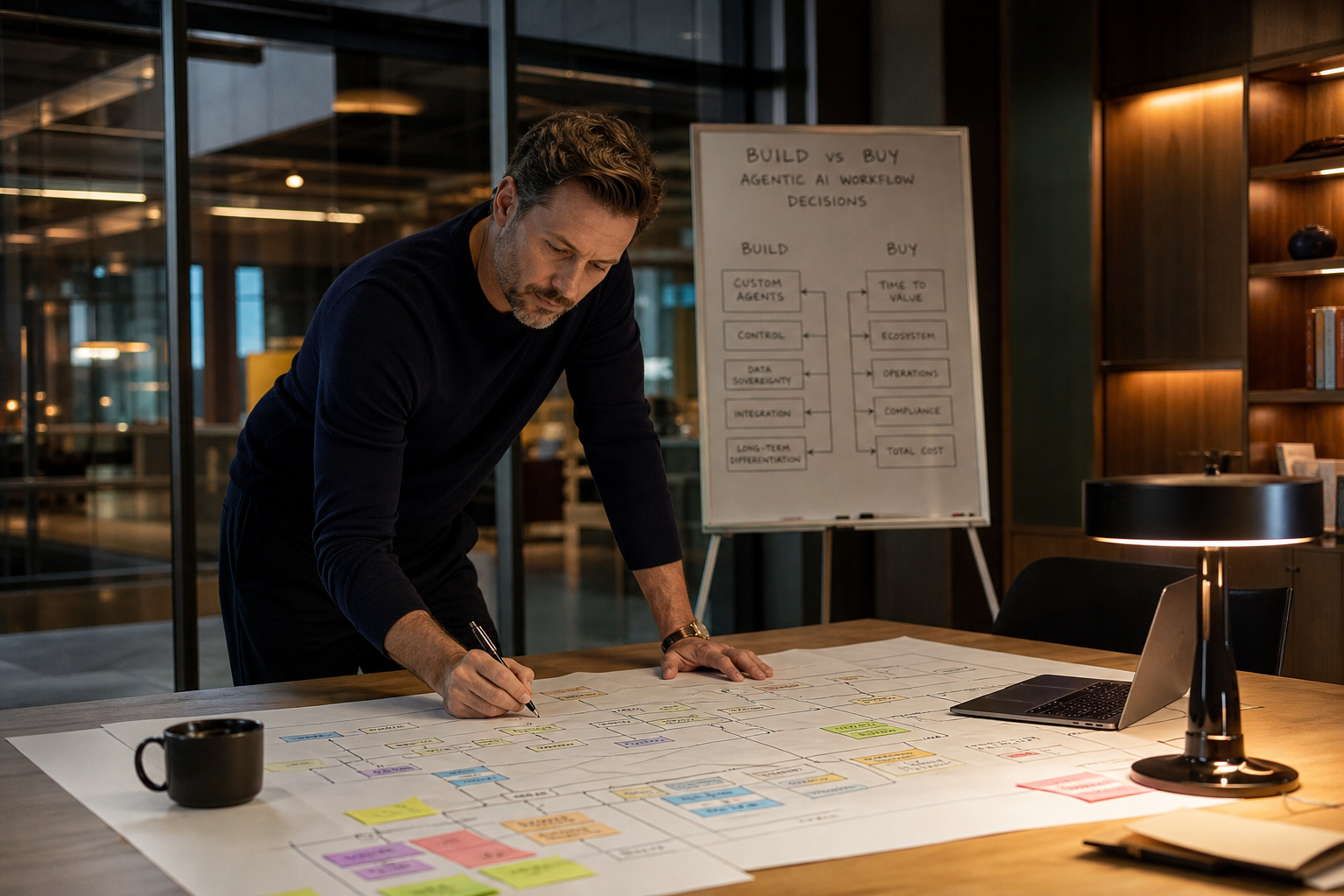
Agentic AI Workflow Breakdown Enterprise News 2026: Build vs Buy Decisions
Use these 2026 options to align with your stack, risk posture, and talent model.
• Option: Nvidia enterprise agent platform
Best For: SAP, Salesforce, Adobe stacks
Trade-offs: Vendor alignment; integration depth varies
• Option: OpenAI Workspace Agents (GPT-5.5 signals)
Best For: Office workflows, doc-heavy tasks
Trade-offs: Data residency, control granularity
• Option: Anthropic Claude Mythos + Claude Code
Best For: SecOps, compliant execution
Trade-offs: Endpoint hardening, staged rollout
• Option: Open-source orchestration (LangChain, AutoGen, CrewAI)
Best For: Custom pipelines, hybrid clouds
Trade-offs: More engineering, governance effort
• Option: Qwen 3.6 Plus signals
Best For: Cost-flexible experimentation
Trade-offs: Maturity and enterprise wrappers
• Option: Secure agent patterns like NemoClaw
Best For: Risk-sensitive industries
Trade-offs: Emerging patterns, integration work
Context signals
• SAGTEC Global highlighted an agentic orchestration layer serving large customer bases as a path to ROI.
• OpenClaw’s visibility on the TED stage underscored fast-moving open-source agents, useful for R&D and internal tooling.
• IBM Technology’s educational content remains helpful for teams standardizing multi-agent patterns and operations.
Decision rubric
• Where your core business runs on SAP and Salesforce with Adobe assets, prioritize Nvidia-aligned integrations.
• If your workflows are document-centric and collaboration-heavy, evaluate Workspace Agents’ fit for end-to-end execution.
• For security operations, consider Mythos detection patterns with Claude Code as a gated execution layer.
• If talent favors Python and infra-as-code, open-source orchestration plus a vetted model catalog can speed iteration.
30-60-90 Day Rollout Plan for Executable Enterprise Agents
30 days: Scope and pilot readiness
• Pick one workflow with measurable value, low blast radius, and clear SLAs; order-to-cash is a strong candidate.
• Map systems, data contracts, RBAC, and human approval points; define non-goals to prevent scope creep.
• Stand up a sandbox with policy-as-code, synthetic test data, and observability; begin shadow mode tracing.
60 days: Controlled deployment
• Enable limited write actions behind approval gates; predefine rollback plans and incident triggers.
• Implement audit trails across prompts, decisions, tool calls, and artifacts; validate reporting with internal audit.
• Measure KPIs weekly: cycle times, exception rates, accuracy, and policy violation intercepts; tune prompts and tools.
90 days: Scale and harden
• Expand to adjacent steps or geographies; conduct access reviews, SoD checks, and red-team exercises.
• Operationalize with runbooks, on-call rotations, and model/tool versioning; schedule monthly change windows.
• Introduce cost controls and capacity planning; evaluate secondary use cases like collections or renewals.
Where video helps adoption
• For change management and stakeholder updates, create short explainer videos and SOP walk-throughs from internal docs or product URLs. A platform like VidAU AI can turn scripts or URLs into concise video explainers for go-live communications and training in multiple languages.
Create With VidAU
Turn scripts, product URLs, and creative ideas into ad-ready video assets with a structured AI workflow.
Key takeaway
Final Thoughts
April 2026 marked the point where enterprise AI agents moved from talk to action. The fastest path is to prove one valuable workflow under strict governance, measure the KPIs that matter, and scale with observability and policy-as-code.
If your stack centers on Salesforce, SAP, and Adobe, start with the order-to-cash blueprint and a shadow-mode agent. As you approach go-live, consider producing short rollout explainers and SOP videos with VidAU AI to accelerate adoption across regions and teams.
Frequently asked questions
What changed in April 2026 for enterprise AI agents?
April 2026 news signaled a shift to executable, governed agents. Nvidia introduced an enterprise agent platform with Adobe, Salesforce, and SAP signals. OpenAI advanced Workspace Agents, Anthropic unveiled Claude Mythos for cybersecurity, and Claude Code gained computer use. Gartner emphasized rapid adoption with strict governance, auditability, and change controls.
How do I start with an agentic workflow for order-to-cash?
Select a narrow scope like quote-to-invoice, integrate Salesforce and SAP, and use LangChain or AutoGen for orchestration. Enforce RBAC, policy-as-code for discounts and credit checks, and human approvals for exceptions. Track cycle time, accuracy, DSO, and exception rates. Begin in shadow mode, then enable constrained write actions.
When should I choose Nvidia’s platform over open-source frameworks?
Choose Nvidia’s platform if your core systems include SAP, Salesforce, and Adobe, and you prefer vendor-aligned integrations. Choose open-source orchestration like LangChain, AutoGen, or CrewAI if you need customization, hybrid cloud control, and have engineering bandwidth for governance and observability buildout.
What is Claude Code computer use and how do I secure it?
Claude Code computer use enables an execution agent to perform desktop or VM actions. Secure it with sandboxed environments, least-privilege RBAC, policy gates for sensitive operations, comprehensive audit logging, and escalation on anomalies. Roll out in phases: read-only shadowing, approvals for writes, then constrained autonomous windows.
How does Anthropic Claude Mythos fit enterprise risk management?
Claude Mythos was signaled for cybersecurity detection and response use cases, helping surface vulnerabilities and threats. In practice, pair Mythos-style detection with governed execution via Claude Code or traditional SOAR, enforce policy-as-code, and require human approvals for impactful changes. Maintain immutable logs for compliance and forensics.
What KPIs prove value for agentic workflows in finance operations?
Track lead-to-quote cycle time, order and invoice accuracy, DSO and aging improvements, exception rates, approval times, and policy-violation intercepts. Supplement with per-action cost, agent success rate, and rework percentage. For security-related agents, measure mean time to detect and remediate, false positive rate, and change failure rate.
How do OpenAI Workspace Agents compare to Nvidia’s platform?
Workspace Agents focus on document-centric, office-suite workflows and collaboration, with GPT-5.5 signals in April 2026. Nvidia’s platform emphasizes integrations across enterprise ecosystems like SAP, Salesforce, and Adobe. Selection depends on your stack, data residency needs, control depth, and whether your priority is office workflows or core system orchestration.
Where do Qwen 3.6 Plus and NemoClaw fit in 2026?
Qwen 3.6 Plus appeared in April 2026 signals as a cost-flexible option for experimentation. NemoClaw discussions emphasized secure agent patterns relevant to risk-sensitive environments. Both indicate expanding choices for model catalogs and secure orchestration, best used with strong governance, observability, and policy-as-code.
What is the 30-60-90 plan for enterprise agent rollout?
In 30 days, scope a bounded workflow, stand up a sandbox, and gather shadow-mode traces. At 60 days, enable controlled writes behind approval gates, implement full audit trails, and tune for KPI gains. By 90 days, scale to adjacent steps, enforce access reviews and change windows, and operationalize with runbooks and on-call.
Can video help with agent adoption and training?
Yes. Short, role-specific videos accelerate change management, SOPS, and compliance. You can convert internal docs or product URLs into explainer videos and multilingual training assets with a tool like VidAU AI, then distribute them during pilot and go-live to reduce errors and support tickets.